

The Last Movie Stars Traces the Legacy of Paul Newman and Joanne Woodward in Six Dazzling Parts

Joanne Woodward and Paul Newman are the subjects of the new series The Terminal Flick Stars. HBO Max hide explanation
toggle caption
HBO Max
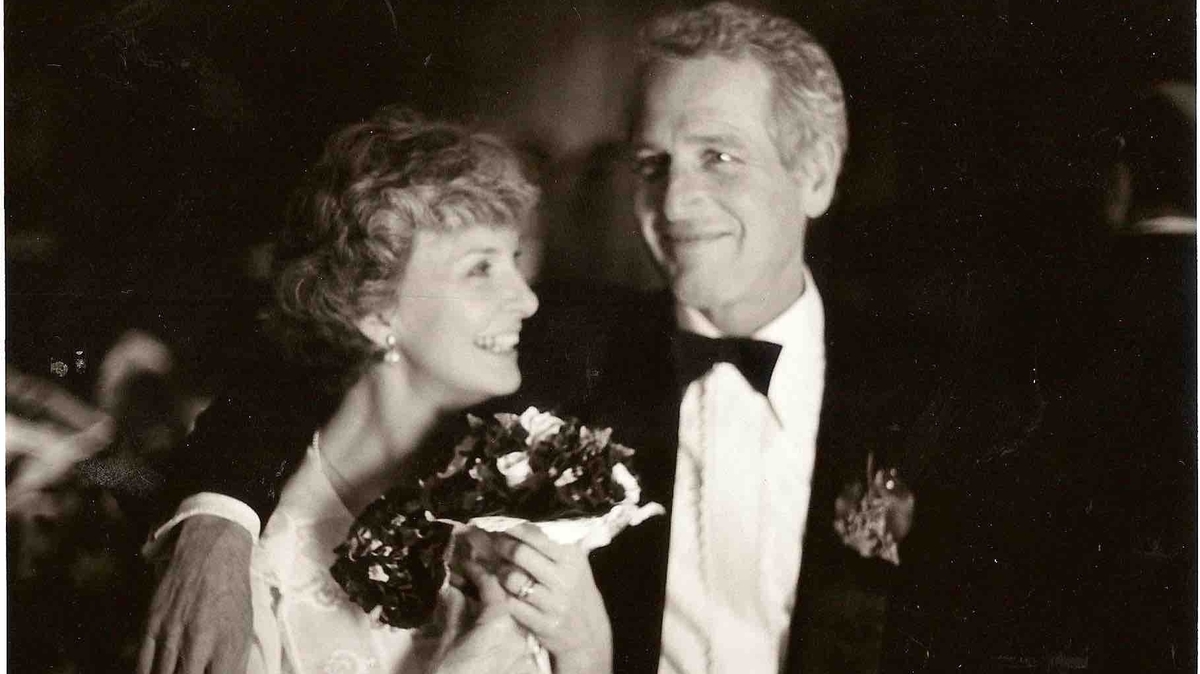
Joanne Woodward and Paul Newman are the subjects of the new series The Concluding Movie Stars.
HBO Max
Ethan Hawke'due south documentary series most Paul Newman and Joanne Woodward, chosen The Final Motion picture Stars, is an unmistakably pandemic-era project. It'south full of video calls, with all of their impulsivity and informality, with managing director Hawke in a variety of sometimes neat and sometimes cluttered hair configurations (both facial and head). We see Hawke talking to his daughter and his wife, talking to Newman and Woodward'due south kids, talking about what he's learned with Vincent D'Onofrio and Laura Linney and Zoe Kazan. Well-nigh of what you will see on screen is these calls aslope hours of clips of Newman and Woodward (and occasionally other actors) working. And it all feels of its isolated moment, because it is a projection perfect for a fourth dimension of restless introspection most life in full general, and thus about celebrity, matrimony and fine art.
Newman laid the groundwork for the documentary
The birth of the series came, Hawke says, from a treasure trove of interview tapes with everyone from Newman'due south start married woman, Jackie Witte, to directors George Roy Hill and Sidney Lumet — tapes that Newman deputed for a planned memoir and and then, much later, burned on what appears to have been something of an impulse. Simply Newman'southward kids (he had 3 with Witte and three with Woodward) later learned that there were transcripts of those tapes, and they asked Hawke if he'd like to direct a documentary using them.
Hawke's solution for making transcripts something to lookout rather than to read is to gather actors to read from them every bit if they were scripts, usually over all those clips of decades of movies and other footage. And then, for instance, George Clooney reads Newman himself; Laura Linney reads Joanne Woodward; Vincent D'Onofrio reads John Huston; and Brooks Ashmanskas has a fantastic time wrapping his voice effectually the words of Gore Vidal (a close friend of the couple who gave the series its proper noun by referring to them as such).
One film, three stories
The Last Movie Stars tells three stories, really, all of them effectively. One is the history of a marriage: Newman and Woodward coming together every bit immature actors; starting a human relationship that all seem to agree was intensely carnal from practically the twenty-four hours they met and remained and so forever; studying at the Actors Studio; growing older and seeing their careers diverge as he became a megasuperstar; staying together despite a path more rocky than their legend has sometimes left room for; finding new paths in philanthropy and television subsequently in their lives. (Newman died in 2008; Woodward is nonetheless alive, only has Alzheimer's and didn't participate direct, although she appears in archival television interview footage.)
The second is a Hollywood history. Hawke explores how Woodward made her style through an manufacture that didn't gloat her nearly equally much as it did her married man. We acquire how today's prestige Goggle box series are not the first such opportunities for actresses neglected by Hollywood. We larn that Newman sank into what some considered a dormant period during his time as an established movie star and how he rebounded with The Verdict. There is fifty-fifty infinite for Vidal, from across the grave, to darkly muse on how the tragic death of James Dean paved the fashion for Newman's success.
And the tertiary is how Hawke and his contemporaries who do voices in the serial and conversation with him on Zoom, some of whom you lot can discover with their arms slung around him in old wire photos from the '90s, look on these legends who inhabited a dissimilar Hollywood than the 1 that they've known. Hawke, for instance, is gently led by his wife in one conversation to think about his own starstruck attachment to Newman's fable before he judges too harshly how stardom commodifies human beings. Revering Newman for beingness from the Actors Studio and not for having bluish optics does not, after all, make Hawke less hungry for connection to someone he didn't know.
How to have heroes
In fact, this third story may be the 1 that was the least likely to work and the one that feels most unusual. Information technology's easy to empathise why the story of Woodward and Newman's marriage and careers is fascinating and why examining it more closely is satisfying; they genuinely did pb extraordinary lives and exit behind dandy art. Information technology's the managing director and his friends entering the conversation and musing to each other in video calls that could seem aimless or self-indulgent. Just here, it gives the series something fresh and timeless to exist about, beyond acting and beyond this industry. It becomes at some level a story nigh how to take heroes in the first identify.
Hawke begins the series talking to these Zoom friends about how remarkable Newman and Woodward were: the art they fabricated, the kids, the clemency piece of work — and he raced cars, too. Several times, you tin can come across Hawke trying to effigy out how to convey how massive they loom in his mind (particularly now, having washed all this research). Can you imagine, he keeps telling people. Tin yous imagine, beingness at the Actors Studio with James Dean and Marilyn Monroe and Marlon Brando? Tin can y'all imagine?
How to process the flaws
But it's a complicated story. Yous can see Hawke wrangling on camera with what Stephanie Newman, one of Newman'south daughters with Jackie Witte, tells him virtually how disturbing the long affair and eventual storybook wedlock of her father and her stepmother was for her mother, who she says also had wanted to be an actress. "She was left with three kids nether the age of five," Stephanie says. "I was a infant."
Hawke is making a series about people whose careers he admires that is admittedly written every bit a dearest letter of the alphabet to much of what they were and did. But where does the pain they caused others alive inside that story? Where does Hawke, every bit an ardent gentleman of Newman and a father himself, put the fact that Newman felt he was besides much of an absent parent for too many years, and that it clearly caused pain to his kids? What part does the extraordinary privilege of having been an absurdly handsome (even he admitted this most himself, essentially) white actor in the 20th century play in contextualizing what Newman was able to accomplish? Not its role in the documentary, so much every bit in the shape of the reverence itself?
It'southward not as elementary as "nobody's perfect"; making allowances is easy. The thesis of the series on this point, I think, is that you lot learn the most from your heroes by not excepting their faults from your admiration of them simply by embracing those faults as integral to who they were and letting all that you adore coexist with all that you don't. And, in this case, paying close attention to how Newman, in particular, behaved afterwards he made some of these errors, and what he did about feeling boundlessly lucky — a theme that comes upwardly over and over.
A word you hear a lot well-nigh famous couples like Newman and Woodward is royalty. "Hollywood royalty." The Last Picture Stars suggests that peradventure royalty is both too much and too little of a label for anyone you admire. Too much, because it puts a dishonest polish on their flaws. Too little, because it robs them of the very things yous can learn the most from, which is a thorough understanding of how they dealt with the times when they were vain or stubborn, non good to each other, not good to others, non like shooting fish in a barrel to honey, or non hands loving.
This is a terrific history; it is an accented feast of flick clips, full of things I didn't know, total of things a lot of people probably don't know. Information technology is rich and thorough when it is operating as a biography. But there is something peculiarly welcome in the moments in which it steps back and becomes a report of generations of artists and of legend itself, legend as a thing then big it tin block out the sun and obscure the messy lessons of other people'southward lives that are, after all, the all-time reasons to written report them.
All vi episodes of The Last Movie Stars are streaming on HBO MAX.
Source: https://www.npr.org/2022/07/21/1112472019/paul-newman-joanne-woodward-the-last-movie-stars-ethan-hawke
Posted by: hughesprieture.blogspot.com
0 Response to "The Last Movie Stars Traces the Legacy of Paul Newman and Joanne Woodward in Six Dazzling Parts"
Post a Comment