

What Is The Genetic Makeup Of Alleles
The term allele (, ; ; modern formation from Greek ἄλλος állos, "other")[1] [2] [3] denotes the variant of a given cistron. In genetics it is normal for genes to show deviations or diversity − all alleles together brand up the set of genetic information that defines a gene.[4] For example, the ABO claret grouping is controlled by the ABO gene, which has six common variants (alleles). In population genetics nearly every living human'due south phenotype for the ABO gene is some combination of only these six alleles.[five] [6]
An allele is a variation of the same sequence of nucleotides that encodes the synthesis of a gene product at the same identify on a long DNA molecule. At the lowest extreme, an allele tin can be based on a single nucleotide polymorphism (SNP).[7] At college extremes, it can exist based on differences upwardly to several thousand base-pairs long.[8] [9]
Most alleles observed issue in little or no change in the part of the cistron production it codes for. Still, sometimes, different alleles tin result in dissimilar appreciable phenotypic traits, such as different pigmentation. A notable case of this is Gregor Mendel'southward discovery that the white and royal flower colors in pea plants were the issue of a single cistron with 2 alleles.
Nearly all multicellular organisms take 2 sets of chromosomes at some indicate in their life cycle; that is, they are diploid. In this case, the chromosomes can be paired. Each chromosome in the pair contains the same genes in the same order, and identify, along the length of the chromosome. For a given gene, if the ii chromosomes contain the same allele, they, and the organism, are homozygous with respect to that factor. If the alleles are different, they, and the organism, are heterozygous with respect to that factor.
Etymology [edit]
The word "allele" is a short form of allelomorph ("other grade", a discussion coined by British geneticists William Bateson and Edith Rebecca Saunders),[10] [xi] which was used in the early on days of genetics to describe variant forms of a cistron detected as unlike phenotypes. It derives from the Greek prefix ἀλληλο-, allelo-, meaning "mutual", "reciprocal", or "each other", which itself is related to the Greek adjective ἄλλος, allos (cognate with Latin alius), meaning "other".
Alleles that lead to ascendant or recessive phenotypes [edit]
In many cases, genotypic interactions between the two alleles at a locus tin be described every bit dominant or recessive, according to which of the 2 homozygous phenotypes the heterozygote virtually resembles. Where the heterozygote is indistinguishable from one of the homozygotes, the allele expressed is the one that leads to the "dominant" phenotype,[12] [thirteen]and the other allele is said to exist "recessive". The degree and design of dominance varies amid loci. This type of interaction was first formally-described by Gregor Mendel. Still, many traits defy this simple categorization and the phenotypes are modeled by co-authorization and polygenic inheritance[14]
The term "wild type" allele is sometimes used to depict an allele that is idea to contribute to the typical phenotypic graphic symbol every bit seen in "wild" populations of organisms, such every bit fruit flies (Drosophila melanogaster). Such a "wild type" allele was historically regarded as leading to a dominant (overpowering – always expressed), common, and normal phenotype, in contrast to "mutant" alleles that lead to recessive, rare, and oft deleterious phenotypes. It was formerly idea that most individuals were homozygous for the "wild type" allele at most factor loci, and that any alternative "mutant" allele was found in homozygous course in a small minority of "affected" individuals, often every bit genetic diseases, and more oft in heterozygous form in "carriers" for the mutant allele. It is now appreciated that most or all gene loci are highly polymorphic, with multiple alleles, whose frequencies vary from population to population, and that a great deal of genetic variation is hidden in the form of alleles that exercise not produce obvious phenotypic differences.
Multiple alleles [edit]
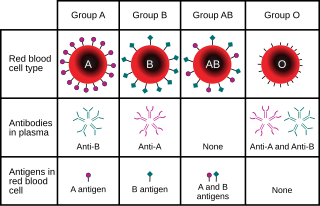
In the ABO blood group arrangement, a person with Type A blood displays A-antigens and may have a genotype IAIA or IAi. A person with Type B blood displays B-antigens and may have the genotype IBIB or IBi. A person with Type AB blood displays both A- and B-antigens and has the genotype IAIB and a person with Type O claret, displaying neither antigen, has the genotype ii.
A population or species of organisms typically includes multiple alleles at each locus among diverse individuals. Allelic variation at a locus is measurable as the number of alleles (polymorphism) present, or the proportion of heterozygotes in the population. A aught allele is a cistron variant that lacks the factor's normal function because it either is not expressed, or the expressed poly peptide is inactive.
For example, at the gene locus for the ABO blood blazon carbohydrate antigens in humans,[15] classical genetics recognizes three alleles, IA, IB, and i, which determine compatibility of claret transfusions. Whatever private has one of six possible genotypes (IAIA, IAi, IBIB, IBi, IAIB, and ii) which produce one of four possible phenotypes: "Type A" (produced by IAIA homozygous and IAi heterozygous genotypes), "Type B" (produced by IBIB homozygous and IBi heterozygous genotypes), "Type AB" produced by IAIB heterozygous genotype, and "Type O" produced by ii homozygous genotype. (It is now known that each of the A, B, and O alleles is actually a class of multiple alleles with different DNA sequences that produce proteins with identical properties: more than lxx alleles are known at the ABO locus.[sixteen] Hence an private with "Type A" blood may be an AO heterozygote, an AA homozygote, or an AA heterozygote with 2 unlike "A" alleles.)
Genotype frequencies [edit]
The frequency of alleles in a diploid population tin can exist used to predict the frequencies of the corresponding genotypes (see Hardy–Weinberg principle). For a simple model, with 2 alleles;


where p is the frequency of one allele and q is the frequency of the alternative allele, which necessarily sum to unity. Then, p ii is the fraction of the population homozygous for the get-go allele, 2pq is the fraction of heterozygotes, and q 2 is the fraction homozygous for the alternative allele. If the beginning allele is dominant to the second and so the fraction of the population that will bear witness the dominant phenotype is p 2 + iipq, and the fraction with the recessive phenotype is q 2.
With 3 alleles:
- and


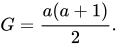
In the instance of multiple alleles at a diploid locus, the number of possible genotypes (G) with a number of alleles (a) is given past the expression:
Allelic say-so in genetic disorders [edit]
A number of genetic disorders are caused when an individual inherits two recessive alleles for a unmarried-gene trait. Recessive genetic disorders include albinism, cystic fibrosis, galactosemia, phenylketonuria (PKU), and Tay–Sachs disease. Other disorders are also due to recessive alleles, simply because the gene locus is located on the 10 chromosome, so that males have merely one copy (that is, they are hemizygous), they are more than frequent in males than in females. Examples include scarlet-greenish colour blindness and frail 10 syndrome.
Other disorders, such equally Huntington's disease, occur when an individual inherits simply i dominant allele.
Epialleles [edit]
While heritable traits are typically studied in terms of genetic alleles, epigenetic marks such equally Dna methylation can be inherited at specific genomic regions in sure species, a process termed transgenerational epigenetic inheritance. The term epiallele is used to distinguish these heritable marks from traditional alleles, which are defined by nucleotide sequence.[17] A specific class of epiallele, the metastable epialleles, has been discovered in mice and in humans which is characterized past stochastic (probabilistic) establishment of epigenetic state that can exist mitotically inherited.[eighteen] [19]
Idiomorph [edit]
The term "idiomorph", from Greek 'morphos' (class) and 'idio' (singular, unique), was introduced in 1990 in place of "allele" to denote sequences at the same locus in unlike strains that accept no sequence similarity and probably do not share a common phylogenetic relationship. Information technology is used mainly in the genetic research of mycology.[20] [21]
See also [edit]
 | Await upwardly allele in Wiktionary, the free dictionary. |
- Allozyme
- Development
- Genealogical DNA test
- Haploinsufficiency
- Meiosis
- Mendelian error
- Mendelian inheritance
- Mitosis
- Penetrance
- Polymorphism
- Punnett square
- Single-nucleotide polymorphism
References and notes [edit]
- ^ "Allele | Meaning of Allele past Lexico". Lexico Dictionaries | English. Archived from the original on 25 July 2020. Retrieved 7 January 2020.
- ^ "allele noun – Definition, pictures, pronunciation and usage notes". Oxford Advanced Learner's Dictionary. Archived from the original on 20 October 2017. Retrieved 29 October 2017.
- ^ "allele Meaning in the Cambridge English Lexicon". Dictionary.cambridge.org. Archived from the original on 10 October 2017. Retrieved 29 Oct 2017.
- ^ "What are variants, alleles and haplotypes? | Homo genetic variation". Archived from the original on 23 December 2020. Retrieved sixteen November 2020.
- ^ Seltsam A, Hallensleben M, Kollmann A, Blasczyk R (Oct 2003). "The nature of diversity and diversification at the ABO locus". Blood. 102 (8): 3035–42. doi:10.1182/blood-2003-03-0955. PMID 12829588.
- ^ Ogasawara Thousand, Bannai M, Saitou N, Yabe R, Nakata M, Takenaka G, Fujisawa K, Uchikawa M, Ishikawa Y, Juji T, Tokunaga K (June 1996). "Extensive polymorphism of ABO blood grouping gene: three major lineages of the alleles for the mutual ABO phenotypes". Human Genetics. 97 (6): 777–83. doi:10.1007/BF02346189. PMID 8641696. S2CID 12076999.
- ^ Smigielski, Elizabeth Chiliad.; Sirotkin, Karl; Ward, Minghong; Sherry, Stephen T. (1 January 2000). "dbSNP: a database of unmarried nucleotide polymorphisms". Nucleic Acids Research. 28 (1): 352–355. doi:10.1093/nar/28.1.352. ISSN 0305-1048. PMC102496. PMID 10592272.
- ^ Elston, Robert; Satagopan, Jaya; Sunday, Shuying (2012). "Genetic Terminology". Statistical Homo Genetics. Methods in Molecular Biology (Clifton, N.J.). Vol. 850. pp. 1–9. doi:10.1007/978-1-61779-555-8_1. ISBN978-1-61779-554-1. ISSN 1064-3745. PMC4450815. PMID 22307690.
- ^ "What effect exercise variants in coding regions have?". EMBL-EBI Train online. 2 May 2019. Archived from the original on xxx October 2019. Retrieved fourteen November 2019.
- ^ Craft, Jude (2013). "Genes and genetics: the language of scientific discovery". Genes and genetics. Oxford English Dictionary. Archived from the original on 29 January 2018. Retrieved 14 Jan 2016.
- ^ Bateson, W. and Saunders, E. R. (1902) "The facts of heredity in the low-cal of Mendel's discovery." Reports to the Development Commission of the Purple Social club, I. pp. 125–160
- ^ Hartl, Daniel L.; Elizabeth W. Jones (2005). Essential genetics: A genomics perspective (quaternary ed.). Jones & Bartlett Publishers. p. 600. ISBN978-0-7637-3527-2.
- ^ "ASPsiRNA: A Resource of ASP-siRNAs Having Therapeutic Potential for Human Genetic Disorders and Algorithm for Prediction of Their Inhibitory Efficacy". G3. vii (9): 2931–2943. September 2017. doi:10.1534/g3.117.044024. PMID 28696921.
- ^ "Allele". Genome.gov. Archived from the original on 28 June 2021. Retrieved iii July 2021.
- ^ Victor A. McKusick; Cassandra L. Kniffin; Paul J. Converse; Ada Hamosh (10 November 2009). "ABO Glycosyltransferase; ABO". Online Mendelian Inheritance in Man. National Library of Medicine. Archived from the original on 24 September 2008. Retrieved 24 March 2010.
- ^ Yip SP (January 2002). "Sequence variation at the man ABO locus". Annals of Human being Genetics. 66 (1): ane–27. doi:10.1017/S0003480001008995. PMID 12014997.
- ^ Daxinger, Lucia; Whitelaw, Emma (31 Jan 2012). "Understanding transgenerational epigenetic inheritance via the gametes in mammals". Nature Reviews Genetics. 13 (3): 153–62. doi:10.1038/nrg3188. PMID 22290458. S2CID 8654616.
- ^ Rakyan, Vardhman Grand; Blewitt, Marnie Eastward; Druker, Riki; Preis, Jost I; Whitelaw, Emma (July 2002). "Metastable epialleles in mammals". Trends in Genetics. 18 (7): 348–351. doi:10.1016/S0168-9525(02)02709-9. PMID 12127774.
- ^ Waterland, RA; Dolinoy, DC; Lin, JR; Smith, CA; Shi, X; Tahiliani, KG (September 2006). "Maternal methyl supplements increase offspring DNA methylation at Axin Fused". Genesis. 44 (9): 401–6. doi:x.1002/dvg.20230. PMID 16868943. S2CID 36938621.
- ^ Glass NL, Lee 50. Isolation of Neurospora crassa A mating type mutants by echo induced betoken (RIP) mutation. Genetics. 1992 Sep;132(1):125-33. doi: x.1093/genetics/132.1.125. PMID: 1398049; PMCID: PMC1205111
- ^ Robert L. Metzenberg; N. Louise Glass (1990). Mating type and mating strategies in Neurospora. , 12(ii), 53–59. doi:10.1002/bies.950120202
External links [edit]
- ALFRED: The ALlele FREquency Database
Source: https://en.wikipedia.org/wiki/Allele
Posted by: hughesprieture.blogspot.com
0 Response to "What Is The Genetic Makeup Of Alleles"
Post a Comment